The Generational Investment Hijrah: A Blueprint for Muslim Family Safety and Ummatic Resilience
By Mujahid Chowdhury | Add me on LinkedIn
Across the United Kingdom, Europe, and the West, Muslim families are facing an unprecedented crisis. Islamophobia is escalating at an alarming rate. In the UK, anti-Muslim hate crimes reached 4,478 offences in the year ending March 2025 — a 92% increase since 2023. Muslims now constitute 45% of all religious hate crimes in England and Wales.
Waiting for the political climate to improve is no longer a viable strategy. The Generational Investment Hijrah Framework (GIHF) is a proactive, strategic response — not a submission to far-right narratives, but a structured community-centric model of strategic diaspora enrichment.
Introduction: A Crisis and a Strategic Response
In Germany, 4,096 anti-Muslim incidents were documented in 2025 — a 33% increase from the previous year. Far-right politics are rising across Europe. Reform UK has consistently led opinion polls since early 2025 and now holds "reasonable ambitions to take control of Parliament." The mainstreaming of "remigration" — the forced or encouraged departure of migrants — has moved from the fringe to the centre of political discourse.
From classical to modern times, Europe has consistently targeted and expelled minorities — Jews, Muslims, Roma, and others. The expulsion of Muslims from Spain in 1492, the expulsion of Jews from England in 1290, and the more recent targeting of Muslim communities are not anomalies — they are patterns.
But economic barriers have historically prevented mass family relocation. The inability to secure sustainable long-term employment in host nations has been the primary obstacle. The GIHF solves both problems — safety and work — through a structured, community-centric model of strategic diaspora enrichment.
"Waiting for the political climate to improve is no longer a viable strategy. The GIHF is strategic diversification, not defeat."
What is the Generational Investment Hijrah Framework?
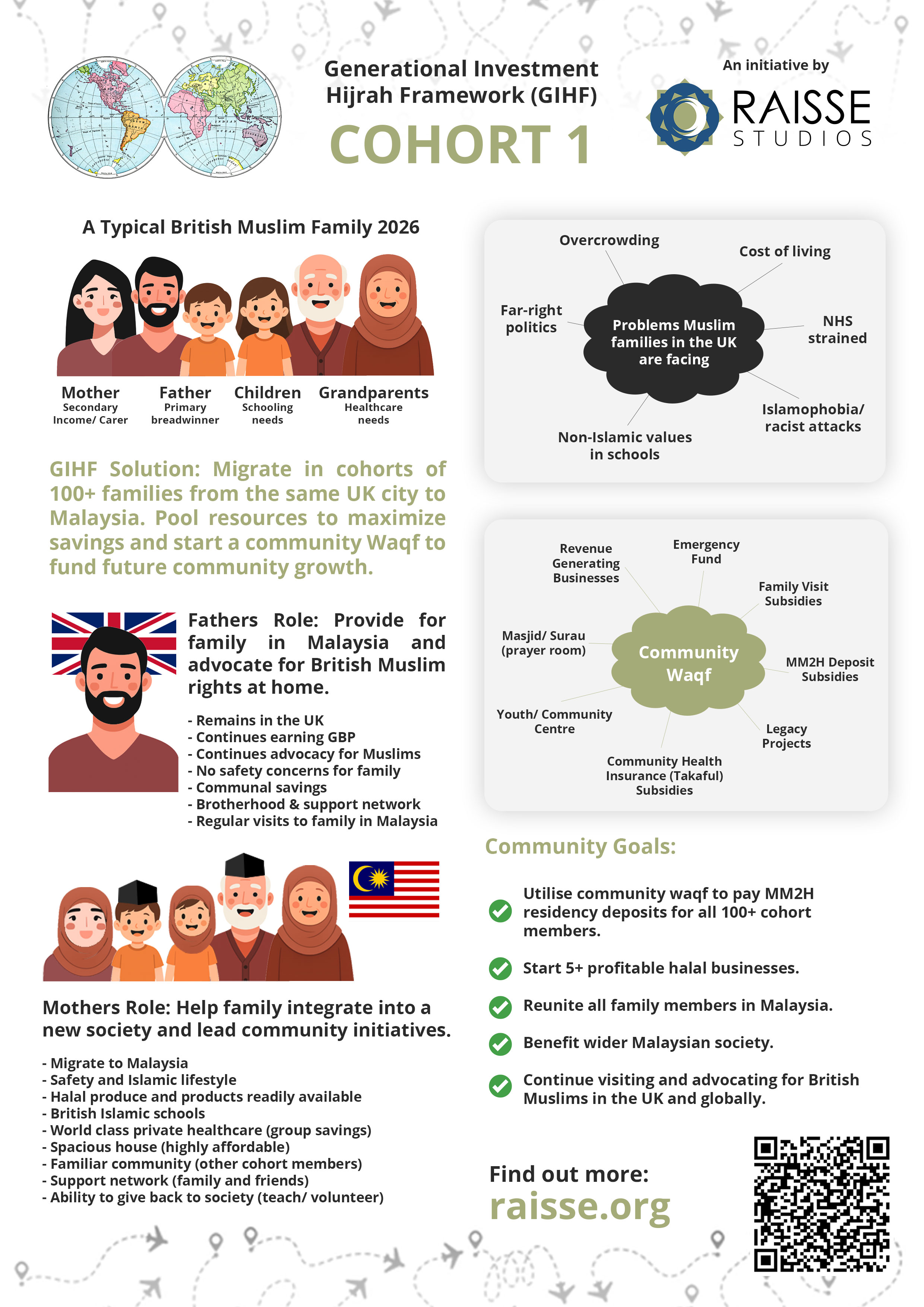
The GIHF is a multi-generational diversification strategy that enables 100+ Muslim families from a single city to pool resources and establish a permanent, legally compliant community in a Muslim-majority nation — while maintaining strong economic and civic ties to their countries of origin.
The Core Model
- Men remain in the home country as primary earners, maintaining high-value earnings and continuing their civic and advocacy work.
- Women, children, and elderly dependents migrate permanently to the host Muslim nation under legitimate student/guardian visa pathways.
- A staggered rotation ensures that a small cohort of men is always present in the host nation, providing paternal and communal mentorship.
- A clear pathway to permanent reunification through the host nation's residency programmes is built into the model from the outset.
| Challenge | GIHF Solution |
|---|---|
| Safety concerns | Families reside in a Muslim-majority nation where Islamic identity is normative |
| Economic barriers | Men maintain Western earnings while families benefit from lower cost of living |
| Immigration hurdles | Student/guardian visas provide a legal pathway to residency |
| Paternal absence | Staggered rotation ensures continuous male mentorship |
| Community loss | 100+ families migrate together, preserving social networks |
| Integration | Structured commitments to language, civic participation, and cultural engagement |
| Long-term sustainability | Waqf investments generate perpetual income for future generations |
Why Malaysia? A Strategic Destination
Malaysia is the ideal first destination for this global model. It offers a unique and compelling value proposition across seven dimensions:
- Islamic & Cultural Affinity — A Muslim-majority nation where Islamic identity is normative. Malaysia is a Global Halal Hub, a leader in the Islamic economy, and a destination of choice for Muslim travellers.
- Economic Viability — The cost of living is 51.6% lower than in the UK without rent, and 57.8% lower when rent is included. A salary earned in GBP, USD, or EUR supports a significantly higher standard of living.
- Educational Excellence — Malaysia is home to numerous prestigious international schools following the British National Curriculum. Epsom College Malaysia achieves 82% of IGCSE grades at A*–B, far surpassing the UK average of 23%.
- World-Class Healthcare — World-class medical care at a fraction of the cost in Western nations.
- Safety and Security — Ranked 13th safest country in the world and 2nd safest in ASEAN on the Global Peace Index 2025.
- Political and Economic Stability — Fitch affirmed Malaysia's sovereign credit rating at 'BBB+' with a Stable outlook. GDP grew by 5.2% in 2025.
- Clear Pathway to Permanent Residency — The MM2H (Malaysia My Second Home) programme provides a structured, transparent pathway to permanent residency — something that is difficult or impossible in many other Muslim-majority nations.
| Criterion | Malaysia | UAE (Dubai) | Turkey | Qatar |
|---|---|---|---|---|
| Cost of Living (vs. UK) | 52–58% lower | 10–20% higher | 40–50% lower | 20–30% higher |
| Pathway to Permanent Residency | MM2H (clear) | Difficult | Difficult | Limited |
| Islamic Environment | Muslim-majority, moderate | Muslim-minority | Muslim-majority, secular | Muslim-majority |
| Integration for Muslim Families | High | Moderate | High (cultural barriers) | Moderate |
| Long-Term Settlement | High | Low | Low | Low |
The Vision: A Network of Safe Havens for the Ummah
This framework is not limited to the UK or Malaysia. It is a replicable model for any Muslim community anywhere in the world facing rising Islamophobia and political uncertainty.
The GIHF can be adapted by Muslim communities in the United Kingdom (London, Birmingham, Manchester, Bradford, Leicester), across Europe (France, Germany, the Netherlands, Sweden, Denmark), in North America (the United States, Canada), and in Australia (Sydney, Melbourne). The vision is a network of safe havens across the Muslim world — Malaysia, Turkey, the UAE, Qatar, Oman, and other willing nations — where Muslim families can live safely, contribute to local economies, and maintain strong ties to their countries of origin.
Muslims in the West engaging in da'wah and civic life, and Muslims building safe havens in the Muslim world, are complementary strategies, not contradictory ones. The West's role: da'wah, advocacy for Muslim rights, and the strengthening of Muslim institutions. The Muslim world's role: safe havens for the Ummah — places where families can live safely, children can grow up in an Islamic environment, and the Ummah can regroup and plan for its collective future.
"The GIHF is not a one-way transaction. It is a partnership between the Muslim community and the host nation — a partnership in which both parties benefit."
A Win-Win Partnership
For the host nation: skilled families bring capital, expertise, and global connections; the community contributes to the host nation's ambition to be a global Islamic hub; professionals share skills with local institutions; 150–250 direct jobs are created for local citizens; and RM 5–15 million is invested in property, with RM 3–6 million in school fees.
For the community: a Muslim-majority environment where Islamic identity is normative; economic viability through a lower cost of living supported by Western earnings; access to British-curriculum schools; a clear pathway to permanent residency; and Waqf assets and property providing a lasting generational legacy.
The Financial Architecture: A Real-World Scenario
To demonstrate viability, the framework presents a detailed financial scenario for a cohort of 100 British-Muslim families transitioning to Malaysia. With 100 UK-based fathers earning £35,000 per annum (RM 196,000) and 10 female teachers on Employment Passes, total gross annual income reaches RM 21,168,000.
After collective men's living costs in the UK (RM 5,980,800 per year) and full Malaysia-based family expenditure including school fees (RM 9,240,000 per year), the cohort operates with meaningful surplus — enabling Waqf investment from Year 1.
Revenue-Generating Waqf Businesses
| Business Venture | Start-Up Cost (MYR) | Annual Revenue (MYR) | Annual Profit (MYR) |
|---|---|---|---|
| Halal Café / Restaurant | RM 500,000 | RM 1,200,000 | RM 300,000 |
| Co-Working Space | RM 800,000 | RM 1,500,000 | RM 400,000 |
| Event & Conference Hall | RM 600,000 | RM 900,000 | RM 250,000 |
| E-Commerce / Halal Distribution | RM 300,000 | RM 800,000 | RM 200,000 |
| Agricultural Land | RM 1,500,000 | RM 1,000,000 | RM 500,000 |
| Total | RM 3,700,000 | RM 5,400,000 | RM 1,650,000 |
Long-Term Financial Sustainability
| Metric | Year 1 | Year 5 | Year 10 | Year 15 |
|---|---|---|---|---|
| Annual Waqf Profit | RM 0 | RM 2.2M | RM 4.9M | RM 7.9M |
| Cumulative MM2H Fund | RM 0 | RM 3.8M | RM 17.8M | RM 40.2M |
| Families on MM2H | 0 | 7 | 35 | 80 |
| Waqf Asset Value | RM 4.7M | RM 22.0M | RM 70.0M | RM 190.0M |
By Year 10, Waqf income alone could fund MM2H deposits for approximately 35 families, with the community approaching full self-sufficiency. By Year 15, Waqf assets reach RM 190 million — a generational endowment that serves the Ummah in perpetuity.
"By Year 15, the GIHF creates a self-sustaining community with RM 190 million in Waqf assets — a generational endowment for the Ummah, built from within the community itself."
A Call to Action
The GIHF is not a theoretical framework. It is an operational blueprint, ready to be piloted by a pioneering cohort of British-Muslim families who are willingsu to invest in their children's future and in the future of the Ummah.
We call upon Muslim scholars, community leaders, Islamic finance institutions, and philanthropists to study this framework and support its implementation. We call upon Muslim families in the UK, Europe, and the West to consider whether this model is right for them and their children.
The time for strategic action is now. The window of opportunity is open. To learn more and request the full GIHF Whitepaper, visit the GIHF project page.